20 Gb/s Arria 10 FPGA Computation Accelerators
- Altera Arria 10 GX FPGA, 160 or 480
- Option for SoC
- Low power: 5-32W: Depends on user application and FPGA Type
- Supported by the Proc Dev Kit FPGA Programming SDK
- Form factor: full-height, single-slot, half-length PCI Express card
- Optional: Low Profile
HawkEye: Low Power Accelerator Board
The HawkEye™ is a low-profile, low power accelerator board built on Altera Arria 10 GX FPGA technology. Designed for compact, power-sensitive environments, it combines robust computational performance with exceptional energy efficiency. The HawkEye delivers up to 480K logic elements (LEs), IEEE-compliant floating-point capability, and peak data transfer rates of 28 Gb/s through 2 × SFP+ links. With its PCIe Gen3 x8 host interface and on-board memory up to 18 GB DDR4, the HawkEye provides a powerful yet efficient solution for modern embedded and industrial computing applications.
Performance and Memory
The HawkEye integrates 1–2 GB DDR4, embedded SRAM, and up to 16 GB DDR4 SoDIMM (for larger FPGA devices), supporting 48 parallel memory ports for maximum bandwidth utilization. As a result, it offers high-throughput data handling and low-latency operation while maintaining exceptional power efficiency, starting at less than 12 W.
Connectivity and Expansion Options
The HawkEye features 2 SFP+ links providing up to 28 Gb/s, alongside a variety of I/O options including RS422, Opto-coupler, external clock, LVDS, LVTTL (3V), and 30V/0.9A output. Furthermore, the platform can operate either as a PCIe-based compute accelerator or in stand-alone mode, delivering flexibility for diverse deployment scenarios. Consequently, it is ideal for applications demanding reliability and low power in a compact footprint.
Optional SoC Capability
The HawkEye family also includes an SoC variant with a dual-core ARM processor based on Arria® 10 GX devices. In addition, a MicroSD slot supports large program images for fully stand-alone operation, enhancing versatility in embedded use cases.
Development Tools and Reliability
Supported by Gidel’s advanced development suite, the HawkEye low power accelerator board simplifies system integration and accelerates deployment. Moreover, the platform has been engineered for high reliability with an MTBF exceeding 1 million hours, ensuring long-term dependability in mission-critical environments.
Why Choose the HawkEye Accelerator Board?
-
Altera Arria® 10 FPGA with up to 480K logic elements
-
Under 12 W power consumption for energy-efficient performance
-
Up to 18 GB DDR4 memory with 48 parallel ports
-
28 Gb/s connectivity via dual SFP+ and PCIe Gen3 x8
-
SoC variant with dual-core ARM processor and stand-alone operation
-
High reliability with MTBF beyond 1 million hours
For more accelerator card options, visit FPGA Compute Acceleration – Gidel

General
- Embedded MLAB (640 bits each) SRAM blocks
- Embedded M20K (20K-bit) SRAM blocks
- Up to 16 GB DDR4 SDRAM (SoDIMM)
- On-board 1 GB DDR4 SDRAM
- Up to 2 GB DDR4 SDRAM for a total of 5.6 GB/s
- Up to 16 GB DDR4 SDRAM for a total of 10.8 GB/s
- Up to 2,736 Embedded 18x19 multipliers
- Up to 2× 12.5/14.1 Gb/s transceivers
- 1.6 Gb/s LVDS performance
- Flexible clocking system
- Temperature monitoring
Optional: low profile
- 1.7M hours
- HE 20G > 350K hours
Connectivity
- 4 X RS422 INPUTS
- Optional input clk
- 1x Optocoupler input
- 1 X RS422 INPUTS
- 2x Opto-coupler inputs
- 2X 3-30V @ 0.8A outputs
- LVTTL IO
- 12V/1A power supply
- 12x LVTTL IO (5V TTL tolerant)
Environmental conditions
- Continuous Operation: 10 - 80% (non-condensing)
- Peak Operation: 10 - 90% (non-condensing)
Development tools
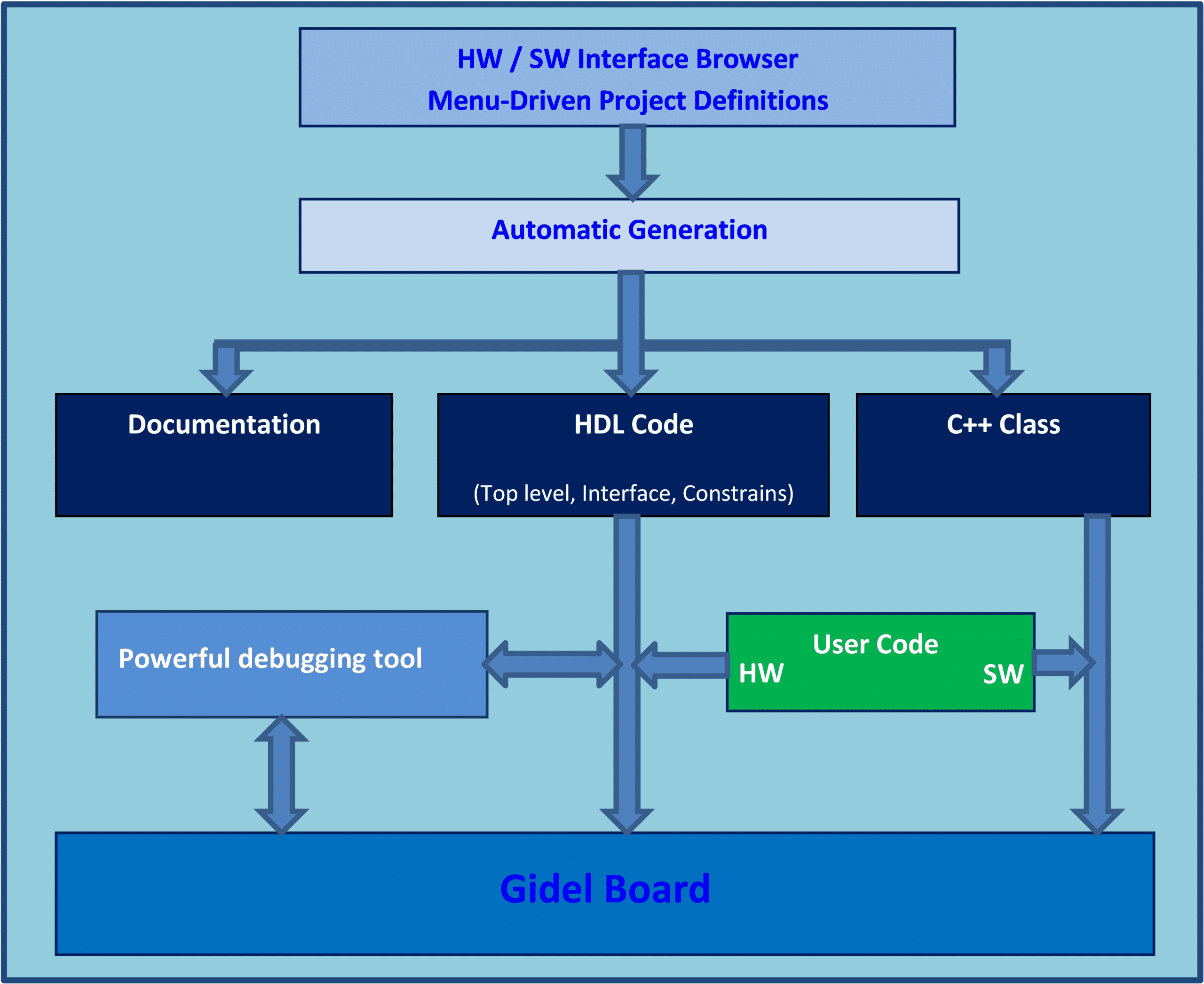
- Generation of FPGA environment code, including all board/IP constraints and a user-logic wrapper
- Generation of a dedicated application driver with an API
- Splitting physical on-board memories into logical memories, each with independent, parallel access to/from user logic
The HawkEye FPGA accelerators is highly flexible and available with various FPGA and connector options.
For additional HawkEye models, including SoC, and other FPGA speed grades, contact Gidel.
HawkEye Accelerator Card: FPGA resources comparison
| Resources | HawkEye-16 Series | HawkEye-48 Series |
|---|---|---|
| FPGA | ||
| FPGA-ALM | ||
| FPGA-M20K | ||
| FPGA-18*19 Multipliers | ||
| Peripheral Memory: | ||
|
|
||
|
|
||
|
|
||
|
|
Development Tools
For HDL Design Flow
- Generation of environment FPGA code, including all board/IP constrains and user logic wrapper
- Generation of dedicated application driver with API support
- Splitting of physical on-board memories into logical memories with independent parallel access to/from user logic
- Altera Tools: Quartus Prime Pro, including QSys and DSP builder
| Name | Description | Type | Size | |
|---|---|---|---|---|
|
HawkEye-20G
|
Datasheet | 125.9 KB | ||
|
HawkEye-20G
|
Block Diagram | PNG | 23.5 KB |
FAQ
The HawkEye is a low-profile, high-reliability accelerator built on Altera Arria 10 GX FPGA technology. It is specifically designed for power-sensitive and compact environments, delivering robust computational performance (up to 480K Logic Elements) while maintaining exceptional energy efficiency, with power consumption starting as low as 12W (and ranging from 5-32W depending on the application).
The board offers a sophisticated memory architecture including up to 18 GB of DDR4 (1-2 GB on-board plus up to 16 GB via SoDIMM). It supports 48 parallel memory ports, allowing for maximum bandwidth utilization and high-throughput data handling with total memory bandwidth reaching up to 10.8 GB/s.
For high-speed data transfer, the HawkEye features 2× SFP+ links providing up to 28 Gb/s aggregate throughput, alongside a PCIe Gen3 x8 host interface. It also includes a diverse range of industrial I/O, such as RS422, Opto-couplers, LVDS (1.6 Gb/s), and LVTTL, making it highly adaptable for complex system integrations.
Yes. The HawkEye family includes an SoC variant featuring a dual-core ARM processor. With its MicroSD slot for large program images, the board can function in a fully stand-alone mode, which is ideal for embedded use cases where a dedicated host computer is not feasible.
The HawkEye is engineered for long-term dependability in demanding environments. It boasts a high reliability rating with an MTBF exceeding 1 million hours. This, combined with integrated board management features like temperature monitoring and a flexible clocking system, ensures stable operation for critical industrial and defense applications.
The board is fully supported by the Gidel ProcDev Kit (FPGA Programming SDK). This toolset simplifies development by generating the FPGA environment code, dedicated application drivers with an API, and allowing the physical on-board memory to be split into independent logical memories for parallel access from user logic.
The HawkEye is a versatile accelerator suitable for a wide range of high-performance fields, including:
-
Signal & Data Processing: DSP, HFT (Computational Finance), and Data Analytics.
-
Network & Security: Deep Packet Inspection, Low-latency Networking, and Network Analysis.
-
Vision & Imaging: Machine Vision, High-Performance Acquisition, and Surveillance.
-
Scientific Research: Life Sciences and 3D Applications.
All Gidel products come with a 12-month warranty, dedicated technical support, and regular firmware and driver updates to ensure high-performance reliability in demanding, long-term deployments.