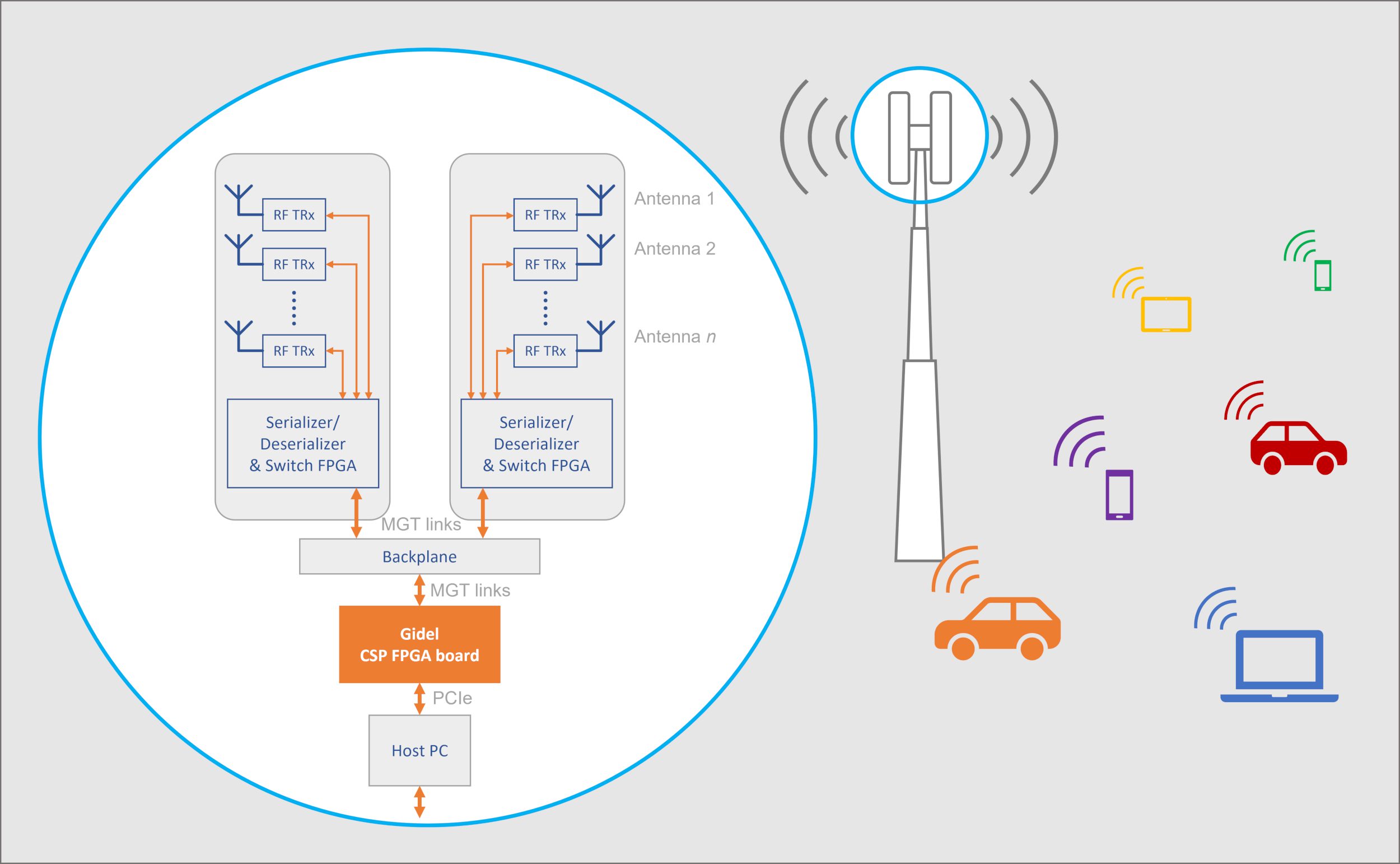

This FPGA wireless research project from TU Berlin shows how Gidel’s FPGA technology enables real-time Massive MIMO processing for advanced wireless communication. As a result, researchers can accelerate 5G and 6G innovation with deterministic performance and extremely low latency. This FPGA wireless research highlights the importance of real-time processing in next-generation communication systems.
As a result, researchers can accelerate 5G and 6G innovation with deterministic performance and extremely low latency.
Learn more about Gidel FPGA Accelerator Cards.
About the TU Berlin EECS Department: TU Berlin EECS.
Advancing FPGA-Based Wireless Research for Massive MIMO
As 5G continues to expand, researchers are exploring ways to deliver higher bandwidth efficiency. With the rapid growth of IoT devices and autonomous systems, networks must exchange data with many terminals in real time. Consequently, the demand for new wireless architectures is increasing.
Massive MIMO is one of the leading technologies addressing this need. It uses large antenna arrays that communicate with multiple users simultaneously. SDMA (Space Division Multiple Access) analyzes the unique characteristics of each terminal, optimizing the downlink and ensuring efficient use of available radio resources.
Real-Time Challenges in Next-Generation Wireless Systems
The main obstacle in Massive MIMO is the requirement for extremely fast, deterministic processing. Because every antenna interacts with every terminal, complex encoding and decoding must happen immediately. However, mobile users constantly move, which means the system must update calculations continuously.
FPGAs are ideal for this task due to their predictable timing, parallelism, and very low latency.
How TU Berlin Advances FPGA Wireless Research with Gidel Technology
The research team led by Prof. Giuseppe Caire at TU Berlin investigates new models for 5G and 6G communication. Their experimental system validates advanced beamforming and real-time wireless processing concepts. Furthermore, the team selected Gidel FPGA hardware—recommended by Intel—to ensure high throughput and precise timing.
Real-Time Processing for Wireless FPGA Research
The prototype demonstrates that a single Gidel FPGA board can communicate with eight terminals at once, often with fewer radio resources than a traditional base station needs for one user. All antenna streams pass through a single FPGA platform, which connects to RF front-ends and network infrastructure using multi-gigabit transceivers and PCIe.
Additionally, Intel Arria 10 FPGAs were chosen for their floating-point performance and exceptional data bandwidth.
Scaling Wireless Infrastructure Efficiently
Massive MIMO systems depend on beamforming to reduce interference and improve link quality. Adding antennas improves accuracy. For example, TU Berlin’s prototype—designed by Dr.-Ing. Andreas Benzin—uses 64 antennas driven by a single Gidel FPGA board. In commercial designs, one Gidel board could support up to 192 antennas. Moreover, multiple boards can be added to scale the platform further.
This work is an important milestone in ongoing FPGA wireless research focused on scaling antenna arrays and improving spectral efficiency.
Long-Term Engineering Partnership
Gidel has supported the TU Berlin research team for more than 15 years. “It all started in 2005,” notes Dr.-Ing. Andreas Kortke. “We were able to focus on our algorithms from day one instead of wasting time building drivers or host interfaces.”
In addition, upgrading to newer Gidel platforms remained simple thanks to consistent hardware architecture and a stable API across generations.
Enabling the Future of Wireless Connectivity
As IoT, autonomous vehicles, and edge computing continue to evolve, the demand for fast and reliable wireless systems will grow. Gidel’s FPGA technology helps meet these requirements by providing high throughput, deterministic real-time processing, and a scalable platform for advanced communication research.
As Gidel CEO Reuven Weintraub explains: “This application demonstrates the potential of our FPGA technology whenever high throughput and real-time processing are required.”