
PCIe x8 (Gen. 3) FPGA Computation Accelerator
- Altera Arria 10 GX FPGA 270, 660, and 1150
- Option for SoC
- Up to 15×14.2 Gb/s reconfigurable transceivers supporting multiple protocols and data rates
- Form factor: PCIe half length
- Up to 40 GFLOPS per Watt
- Low power (8-70W)
- Supported by the Proc Dev Kit FPGA Programming SDK
- Form factor: full-height, single-slot, half-length PCI Express card
Proc10A: High-Performance FPGA Accelerator Card
The Proc10A™ is a flexible, high-performance, low-power FPGA accelerator card built on Altera’s Arria® 10 FPGA. Designed for networking, and demanding data-processing workloads, it not only delivers robust computing power but also ensures excellent energy efficiency, making it ideal for modern systems.
FPGA Accelerator Card Architecture and Memory Capabilities
With up to fifteen 14.2 Gb/s full-duplex transceivers and extensive memory options, the Proc10A FPGA accelerator card delivers outstanding I/O throughput and on-board processing performance. Additionally, its multi-level memory architecture includes:
-
Up to 32 GB DDR3 ECC SODIMM for high-capacity requirements.
-
On-board 1 GB DDR3 SDRAM for low-latency local operations.
-
Dedicated FPGA memory blocks (M20K and MLABs) for real-time data handling.
As a result, the Proc10A is particularly effective for low-latency, high-bandwidth storage, networking, and advanced imaging applications. In addition, its architecture enables engineers to meet demanding performance goals without sacrificing efficiency.
High-Speed Connectivity in a Compute Accelerator
The Proc10A integrates an 8-lane PCI Express Gen3 bridge, enabling fast and efficient co-processing between the host CPU and the FPGA. Furthermore, for applications requiring tightly coupled FPGA-CPU functionality, the Proc10A SoC family includes an embedded ARM processor based on Arria® 10 SoC FPGAs, providing developers with even greater design flexibility. Consequently, the Proc10A supports a wide range of high-performance, mission-critical applications.
Development Tools for High-Performance FPGA Platforms
Supported by Gidel’s advanced development suite, the Proc10A FPGA accelerator card simplifies integration and accelerates deployment. Moreover, it supports C and HDL-based workflows, reducing engineering time, improving system reliability, and shortening time-to-market. Therefore, teams can bring powerful FPGA-based solutions to market faster and with greater confidence.
Why Choose the Proc10A FPGA Accelerator Card?
-
Built on Altera Arria® 10 FPGA for reliable, proven performance.
-
Up to 15 full-duplex 14.2 Gb/s transceivers for high-speed data processing.
-
Multi-level memory architecture with up to 32 GB DDR3 ECC SODIMM.
-
PCIe Gen3 x8 connectivity for seamless FPGA-CPU interaction.
-
SoC variant with ARM processor for tightly coupled processing.
-
Backed by Gidel’s development tools, ensuring faster and more efficient delivery.
For more accelerator card options, visit FPGA Compute Acceleration – Gidel
General
FPGA
Altera Arria 10 GX
Memory
- 1.6 MB embedded MLAB (640-bit) SRAM blocks
- 6.75 MB embedded M20K (20K-bit) SRAM blocks
- Up to 32 GB DDR3 SDRAM (2x 16GB SoDIMMs)
- On-board 1 GB DDR3 SDRAM
Processing Performance
- 270K, 660K, and 1150K logic elements
- Up to 3,036 18x19 embedded 18x19 multipliers
- Embedded M20K and MLAB blocks
- Up to 15x 14.1 Gb/s transceivers
- 1.6 Gb/s LVDS performance
- Up to 2,713 M20K blocks @ 450 MT/s for total of ~5 TB/s
- DDR3 SDRAM for total at 4.5 GB/s
Board Management
- Flexible clocking system
- Temperature monitoring
Form Factor
Single-slot, full-height half-length PCIe card
Power
8-70W: Depends on user application and FPGA Type
Cooling
Passive cooling | Active cooling (fan)
MTBF
> Million hours (With Passive Cooling)
Connectivity
Host Interface
PCIe x8 Gen. 3
I/O
- 3x SFP+
- 1 x QSFP+
- 2x PHS (Gidel High Speed Connector)
GPIO
External IO - 12x LVTTL
Environmental conditions
Temperature
Operating ambient air temperature: 0 – 55° C
Humidity
- Continuous Operation: 10 - 80% (non-condensing)
- Peak Operation: 10 - 90% (non-condensing)
Environmental Compliance
Development tools
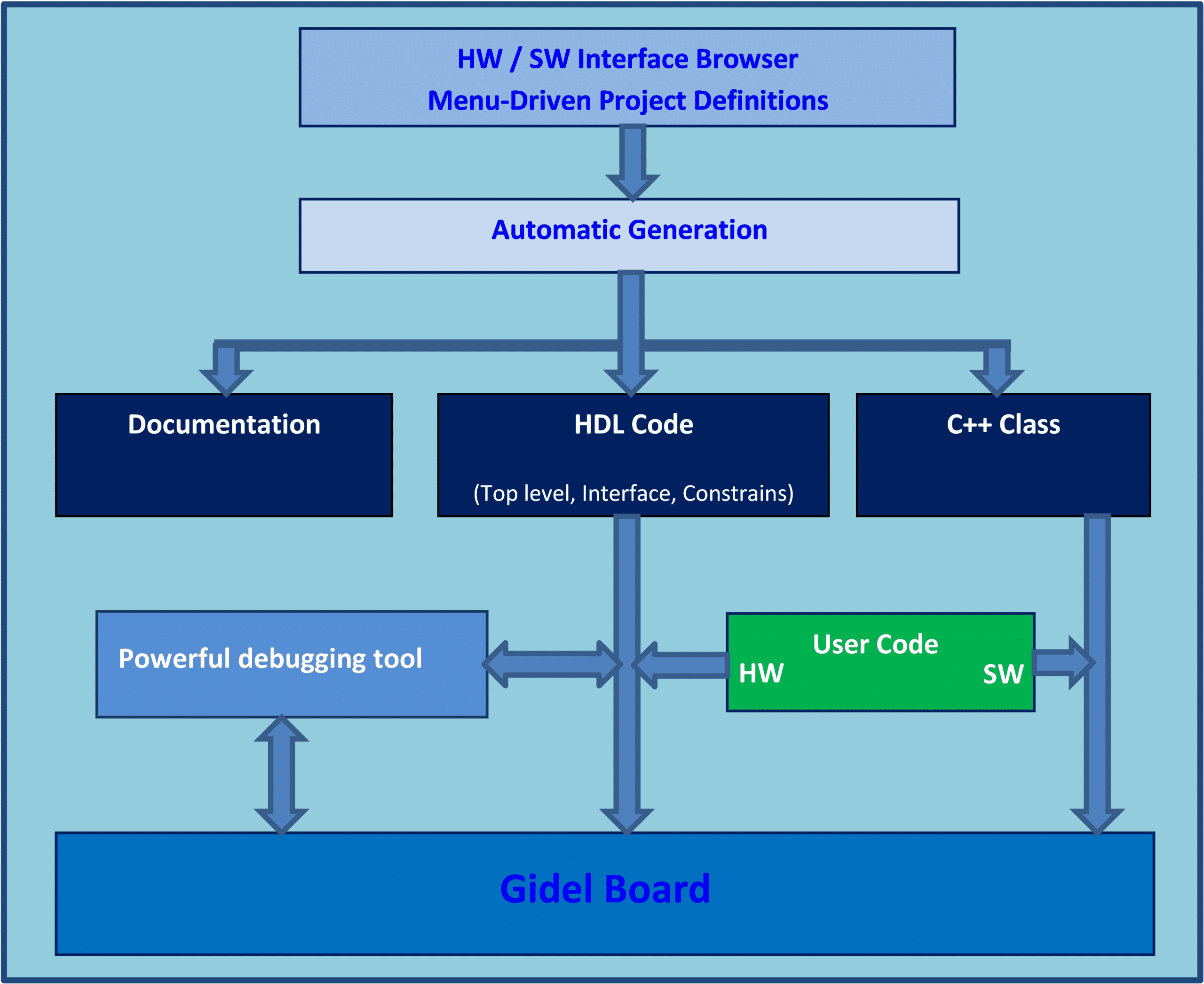
Gidel ProcDev Kit
for HDL design flow:
Generation of environment FPGA code, including all board/IP constrains and user logic wrapper
Generation of dedicated application driver supported by API
Splitting of physical on-board memories into logical memories with independent parallel access to/from user logic
Generation of environment FPGA code, including all board/IP constrains and user logic wrapper
Generation of dedicated application driver supported by API
Splitting of physical on-board memories into logical memories with independent parallel access to/from user logic
Altera Tools
Quartus Prime Pro, including QSys and DSP builder
The Proc10A FPGA accelerators is highly flexible and available with various FPGA and connector options.
For additional Proc10A models, including SoC, and other FPGA speed grades, contact Gidel.
Proc10A Accelerator Card: FPGA resources comparison
| Base model | Proc10A-027 Series | Proc10A-066 Series | Proc10A-115 Series |
|---|---|---|---|
| FPGA | Altera Arria 10 GX 270 | Altera Arria 10 GX 660 | Altera Arria 10 GX 1150 |
| FPGA-ALM | 101,620 | 250,540 | 427,200 |
| FPGA-M20K | 750 | 2,133 | 2,713 |
| FPGA - 18 x 19 Multiplier | 1,660 | 3,556 | 3,036 |
| Peripheral Memory: | |||
|
|
1 GB | 1 GB | 1 GB |
|
|
5.6 GB/s | 5.6 GB/s | 5.6 GB/s |
|
|
0, 8,16 GB | 0, 8,16 GB | 0, 8,16 GB |
|
|
8.96 GB/s | 8.96 GB/s | 8.96 GB/s |
|
|
0, 8,16 GB | 0, 8,16 GB | 0, 8,16 GB |
|
|
8.96 GB/s | 8.96 GB/s | 8.96 GB/s |
Development Tools
Proc Dev Kit
For HDL Design Flow
For HDL Design Flow
- Generation of environment FPGA code, including all board/IP constrains and user logic wrapper
- Generation of dedicated application driver with API support
- Splitting of physical on-board memories into logical memories with independent parallel access to/from user logic
- Altera Tools: Quartus Prime Pro, including QSys and DSP builder
| Name | Description | Type | Size | |
|---|---|---|---|---|
|
Proc10A
|
Datasheet | 120.1 KB | ||
|
Proc10A
|
Block Diagram | PNG | 48.3 KB |

Case Studies
Case Study
Leonardo Solis-Vasquez and Andreas Koch.
Technische Universität Darmstadt, Embedded Systems and Applications (ESA) Group, Darmstadt, Germany

FPGA Wireless Research Powered by Gidel Technology
Discover how TU Berlin utilizes Gidel technology in their latest FPGA wireless research to enable real-time Massive MIMO processing. This…
Read more

Gidel Launches Real-Time JPEG Compression IP
Gidel, a technology leader in cutting-edge Vision and Imaging solutions based on FPGAs, today announced a new real-time JPEG Compression…
Read more

Gidel Launches Real-Time Reversible Compression IP
Gidel, a technology leader in high-performance accelerators utilizing FPGAs, today announced a new Reversible Compression IP. This breakthrough solution reduces…
Read more

FPGA Acceleration Powers CHREC’s Reconfigurable Supercomputer
Discover how CHREC utilized Gidel’s FPGA acceleration technology to build Novo-G, the world’s fastest research-focused reconfigurable supercomputer. Learn how our…
Read more
FAQ
The Proc10A is a flexible, high-performance FPGA accelerator card built on Altera Arria 10 technology (with options up to 1150K Logic Elements). It is designed for demanding networking and data-processing workloads, delivering up to 40 GFLOPS per Watt. It balances robust computing power with excellent energy efficiency, making it ideal for low-latency, high-bandwidth applications.
The Proc10A features a sophisticated multi-level memory architecture to ensure maximum throughput:
-
High Capacity: Up to 32 GB DDR3 ECC SODIMM for large datasets.
-
Low Latency: 1 GB of on-board DDR3 SDRAM for local operations.
-
Real-Time Speed: Extensive embedded memory (M20K and MLABs) providing an aggregate internal bandwidth of approximately 5 TB/s.
The card is a connectivity leader, featuring up to 15 full-duplex 14.2 Gb/s reconfigurable transceivers. These support multiple protocols and data rates, providing outstanding I/O throughput. For host communication, it integrates an 8-lane PCIe Gen3 bridge to enable fast co-processing between the host CPU and the FPGA.
Yes. For applications requiring tightly coupled FPGA-CPU functionality, the Proc10A SoC family includes an embedded ARM processor. This allows developers to create autonomous or semi-autonomous systems where the FPGA and CPU work in tandem without relying exclusively on an external host.
The Proc10A is engineered for long-term stability, featuring an MTBF exceeding 1 million hours (with passive cooling). It also includes integrated board management tools, such as temperature monitoring and a flexible clocking system, ensuring it meets the rigorous reliability standards of data centers and industrial environments.
The Proc10A is fully supported by the Gidel ProcDev Kit (FPGA Programming SDK). This SDK simplifies integration by generating the environment FPGA code, board/IP constraints, and a user-logic wrapper. It also generates a dedicated application driver and API, while allowing physical memories to be split into logical memories for independent, parallel access.
Due to its high logic density and massive I/O, the Proc10A is the ideal choice for:
-
Financial & Data Analytics: Computational Finance (HFT) and Data Centers.
-
Networking & Security: High-speed Networking, Network Analysis, and Deep Packet Inspection.
-
Advanced Imaging: High-Performance Acquisition Systems, Machine Vision, and 3D Applications.
-
Scientific Computing: Life Science applications and Linear Algebra.
All Gidel products come with a 12-month warranty, dedicated technical support, and regular firmware and driver updates to ensure high-performance reliability in demanding, long-term deployments.
Need more? Check out our other products!




1 / 1
