
Gidel’s InfiniVision technology enables a complete 360-degree camera system for VR and AR applications. It allows developers to capture synchronized, high-quality images from large camera arrays and create immersive panoramic content for next-generation media, sports, and interactive experiences.
Learn more about Gidel InfiniVision.
Watch the demonstration here: InfiniVision Example.
360 Degree Camera System Built with Gidel InfiniVision
A leading semiconductor company selected Gidel to help develop a highly scalable 360-degree camera system for its VR product division. The system captures panoramic content using 24 synchronized MIPI sensors. Intel, acting as a technology advisor to the customer, recommended Gidel because of its strong expertise in FPGA-based imaging and vision systems.
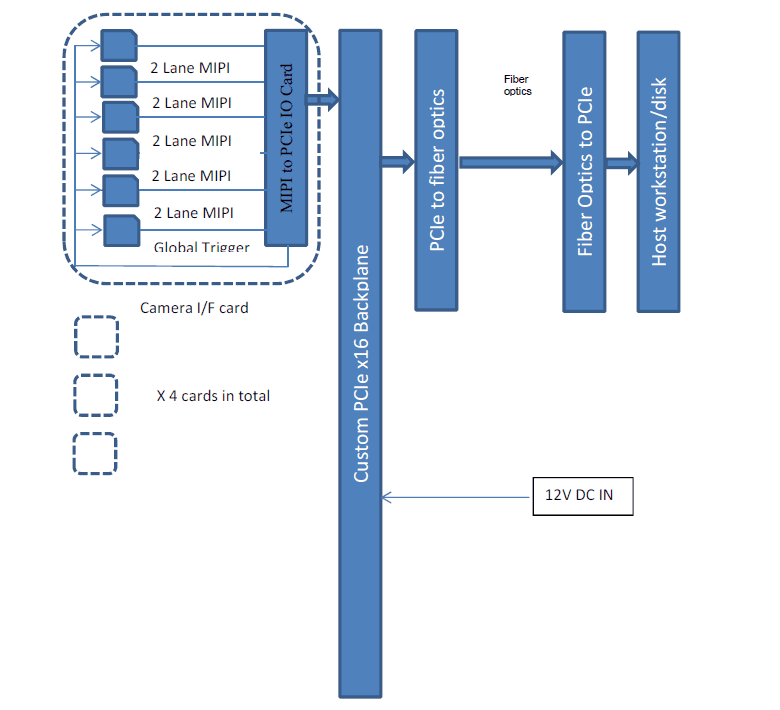
To support this project, Gidel designed a custom FPGA I/O card that enables simultaneous acquisition from all 24 cameras. This infrastructure allows the semiconductor company to generate high-resolution VR content with precise control over timing, exposure, and sensor behavior.
FPGA Architecture for 360 Degree Camera Arrays
Each Gidel FPGA I/O card supports up to six MIPI cameras. Therefore, the full solution uses four synchronized cards to capture the entire 24-camera array. This modular design makes the system scalable, flexible, and easy to adapt to new VR or AR devices.
Furthermore, Gidel’s hardware handles frame aggregation and timing alignment. As a result, the system maintains strict synchronization across all cameras—an essential requirement for stitching accurate 360-degree images.
Synchronized Capture for 360 Degree Imaging
Gidel’s FPGA technology ensures that every camera in the array operates with matching exposure timing, white balance, color processing, and gamma correction. This alignment dramatically improves stitching quality and reduces image mismatches during panoramic reconstruction.
Additionally, the FPGA I/O cards manage camera enumeration, initialization, and control operations. Developers gain predictable, deterministic behavior for all 24 sensors, which is crucial for real-time VR pipelines.
Software API for Full Camera-Array Control
Alongside the hardware, Gidel created a dedicated software API that exposes system-level control to application developers. The API simplifies tasks such as camera reset, initialization, frame synchronization, and data handling. Consequently, software teams can integrate the solution into larger VR/AR platforms without needing FPGA expertise.
This combination of FPGA hardware, real-time acquisition, and a flexible software API delivers an end-to-end imaging pipeline that is extremely difficult to achieve using conventional architectures.


