
The Stratix 10 NX module marks a major step forward in AI acceleration and vector processing for embedded and high-bandwidth systems. Gidel now brings Intel’s newest FPGA technology to a ready-to-use module and PCIe board, allowing developers to reach real-time performance levels that previously required large GPUs.
Stratix 10 NX FPGA Module Technology in Proc10N and Proc1C10N
Gidel has officially released its Proc10N FPGA module and Proc1C10N PCIe board, the first commercial platforms built around the Intel Stratix 10 NX. These compact, high-performance solutions target compute-intensive applications that require high data rates and low latency. The Stratix 10 NX integrates advanced Tensor blocks for deep learning acceleration and pairs them with high-bandwidth HBM2 memory, offering exceptional compute density and memory throughput. Gidel, a Titanium member of the Intel Partner Alliance, is among the first to bring this device to the market.
AI, vector processing, security, and more
The combination of Tensor blocks and HBM2 memory enables the Stratix 10 NX to excel in real-time, high-throughput tasks. As a result, developers can use these boards for demanding workloads such as AI inference, video analytics, cybersecurity, 5G processing, radar, and other bandwidth-intensive algorithms. Thanks to its small size and efficient architecture, it also fits well in embedded, low-power, and weight-constrained systems.
High-Bandwidth Performance of the Stratix 10 NX Module
The Proc10N module supports 1,600 Gb/s of customizable I/O, Tensor compute blocks capable of 143 INT8 TOPS per block, and 400 GB/s of HBM2 throughput. Developers can use this performance for convolution layers, FFTs, encoders, linear algebra, filtering, and similar operations. Despite its capabilities, the module remains extremely compact at only 97.4 × 101 mm, making integration simple even in space-restricted designs.
Intel’s benchmark tests show strong results. For example, Stratix 10 NX delivers up to a 9.5× acceleration factor for LSTM batch processing compared to NVIDIA’s V100 GPU. It also achieves superior performance-per-watt compared to many GPUs and other FPGAs.
Fast development with ProcVision and ProcDevKit modular tools
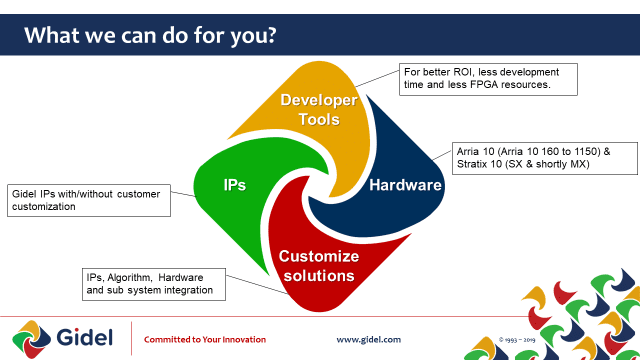
Gidel’s modular tools allow developers to build FPGA-based solutions quickly. They also reduce project risk, complexity, and cost. The Proc10N module fits Gidel carrier boards or a user-designed board through the ProcDevKit. This flexibility supports fast prototyping and smooth product deployment.
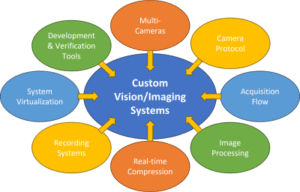
The ProcVision development suite accelerates FPGA development and system integration. It offers a unified toolchain for acquisition, buffering, FPGA flows, debugging, and simulation. Developers can focus on algorithms instead of low-level infrastructure.
The Proc Dev Kit tool simplifies hardware setup and real-time system testing. It generates Application Support Packages (ASP) that match each project’s configuration. These packages speed up FPGA–host integration and reduce development time.
ProcVision also supports distributed multi-unit acquisition. This allows synchronized capture across many cameras or sensors. The capability is essential for robotics, autonomous systems, 360° imaging, and high-volume inspection.
Availability and custom designs
Gidel currently ships the Proc10N and Proc1C10N in limited quantities. The company and its partners are already working on custom system designs for a wide range of industries. Developers interested in evaluating the Stratix 10 NX module or planning new FPGA-based systems are invited to contact Gidel’s support team for guidance and design assistance.